Stop Letting Employees Own Production Flows
Power Automate · Ownership · ALM
Stop letting employees own production flows.
A flow is not production-ready while its continuity depends on one person's account, license, password, role, or employment.
A maker builds an automation, tests it, and publishes it. Months later the maker changes role, loses a premium license, accepts a new Conditional Access policy, or leaves the company. The business process stops even though nobody changed the flow.
This is not a rare technical edge case. It is a predictable ownership failure. A production automation needs an operating identity with a lifecycle designed around the process—not around the person who first clicked Create.
Co-owners improve access to a flow. They do not redesign the identity that runs it.
Owner, connection, reference, and caller
Changing a value labelled Owner feels decisive. In Power Automate, it is only one part of runtime behavior.
| Layer | What it determines | What it does not prove |
|---|---|---|
| Primary owner | Management authority, licensing context, request allocation in relevant scenarios | That every connector action uses the same identity |
| Connection | Stored authentication to a specific service | That the connection is portable between environments |
| Connection reference | Solution component that points actions to an environment-specific connection | That the referenced connection has least privilege |
| Run-only user or caller | Who starts an instant flow and, depending on configuration, which connections are supplied | Who owns scheduled and background execution |
Three ownership models
Named employee account
Convenient for personal productivity and development. Fragile for a departmental or enterprise process. Employment changes, license removal, MFA resets, password changes, Terms of Use prompts, and Conditional Access can affect unattended token refresh.
Shared service account
Separates the process from one employee, but remains a human-style account with password, MFA, sign-in, licensing, and shared-access concerns. It is often an operational compromise, not the cleanest target architecture.
Service principal application user
A non-human identity can own and run flows without being tied to an employee lifecycle. Microsoft recommends it for mission-critical flows and DevOps deployment scenarios. It supports least-privilege role assignment and more intentional credential management.
A service principal is not a free generic account.
Premium use, request allocation, environment roles, connector support, secrets or certificates, and monitoring still need explicit design.
Ownership changes begin with solutions
Microsoft's in-place ownership change applies to solution-aware cloud flows. For non-solution flows, the owner forms part of the flow identity and cannot simply be replaced in place. That makes moving production flows into solutions an operational prerequisite, not just an ALM preference.


The owner is not the connection
A solution-aware flow binds connector actions to connection references. During import, each reference is mapped to a connection in the target environment. This is the seam that lets Dev, Test, and Production use different identities without editing the flow definition.
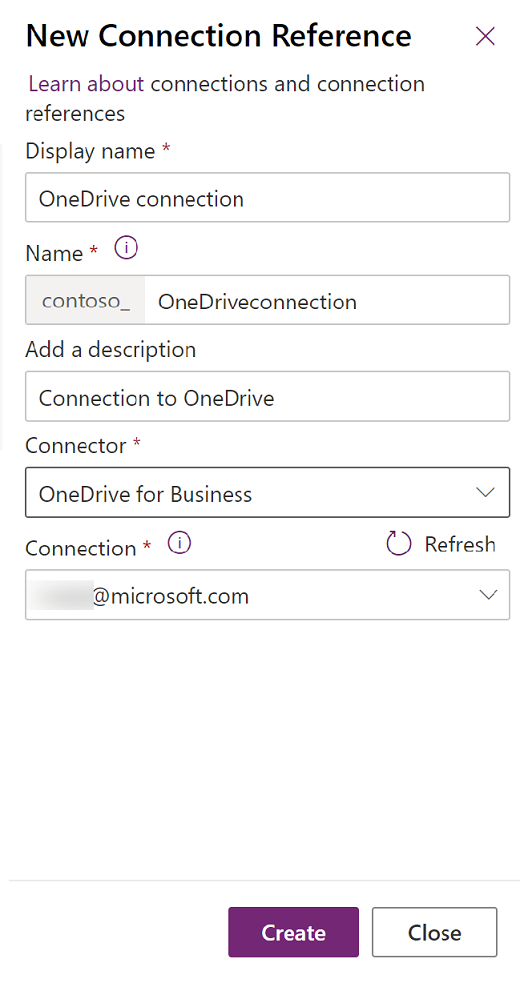
After changing ownership, inspect every action and every reference. A flow owned by a service principal can still rely on a connection created by a departing maker. Conversely, a well-governed connection reference can outlive multiple flow versions.
The licensing paragraph you cannot skip
Service-principal-owned flows are non-interactive and have special licensing and request-limit implications. Microsoft states that premium service-principal-owned flows generally require a Power Automate Process or per-flow license, unless an applicable exemption such as operation in the context of a Dynamics 365 application applies.
Request allocations also vary by context. Standard-only flows, flows associated with Power Apps, and Dynamics 365 scenarios do not all receive the same capacity. Do not approve an ownership migration until the intended production context has been checked against the current licensing documentation.
Also plan for propagation: Microsoft notes that an ownership change for a scheduled or automated flow can take up to seven days to affect the licensing and request-limit context.
A defensible production pattern
- Place the flow and its dependencies in a dedicated solution.
- Create connection references inside that solution; do not let new actions silently create unrelated references.
- Create a service principal application user in the target environment and assign only the required Dataverse roles.
- Create or share the required connector connections according to connector support and solution behavior.
- Change the primary owner of the solution-aware flow.
- Map every connection reference during deployment to Test and Production identities.
- Turn on the flow, execute positive and negative permission tests, and inspect downstream audit logs.
- Document licensing, request limits, credential rotation, monitoring, support ownership, and recovery.
- No employee is a single point of failure for editing, deployment, connections, or alerts.
- Production connections are not reused from development.
- The identity can access only the sites, mailboxes, tables, queues, and APIs the flow needs.
- Failures go to a monitored team channel or incident system, not one person's inbox.
- The team can rotate a secret or certificate without rebuilding the flow.
- A named team owns the process even though a non-human identity runs it.
A production flow needs a business owner, an operational owner, and a runtime identity. They do not have to be the same thing.


Comments
Post a Comment